Home
Reviews Child Guitar
Top Picks
Acoustic by Brand
Acoustic-Electric
How to Play Free Video Lessons
Tabs
Sheet Music
Read Tablature
Learn Chords
Chord Library
Tuning
More Contact
Privacy Policy
Listen to Music
 

Basic Guitar Chord Charts

Basic guitar chord charts are easy to read, once you know how the guitar strings and frets are represented in the diagrams. And you must know the symbols that represent which guitar strings to play.

Guide to Chord Charts

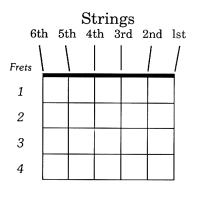
A basic chord chart illustrates how to form a chord. The most basic chord chart is a simple “chord box” (diagram 1) that shows the fretboard in a vertical orientation, with the six strings running up and down. The low E (thickest) or 6th string is on the left, and the high E (thinnest) or 1st string is on the right. The horizontal lines are the frets. The thick solid line at the top of the box represents the nut of the guitar, the end of the fretboard.

Diagram 1:

Basic Guitar Chord Charts

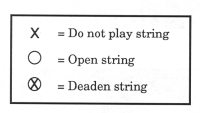
In the charts below, basic symbols represent which strings to play (diagram 2). The "X" (do not play string) means not to strum or touch that string. The "O" (open string) indicates that the string is to be played, but no finger should be touching that string. The "XO" in the chart means that the string should be deadened, or muffled.

Diagram 2:
Chord Diagram Key

Finger Charts

The numbers within the black circles represent the fingers to be used. A guitarists' fingers are numbered 1 (index finger) thru 4 (pinky), as shown in diagram 3 below.
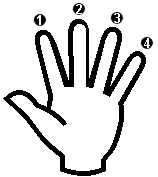
Diagram 3:
Guitar Finger Numbers

It is common to build three chord guitar songs on the I (tonic), IV (subdominant) and V (dominant) chords of a given key. For example, in the key of D, this represents the D major, G major, A major chords. Learn these three basic guitar chords and you can instantly play many easy guitar songs! For example, try the Hal Leonard 3 Chord Songbook.

Return from Basic Guitar Chord Charts to Free Guitar Chord Charts


Return to Play Acoustic Guitar HOME

footer for Basic Guitar Chord Charts page